
IELTS Writing Task 1 – Process Diagram (Machine: Coffee Maker)
A process diagram that shows how a machine works. Follow the arrows, count the stages, find the main parts, and turn every label into a sentence that says what happens and where. Then try the practice task below.
Key points
The example question and chart from the video
The diagram below shows how a drip coffee maker works. Summarise the information by selecting and reporting the main features, and make comparisons where relevant. Write at least 150 words.
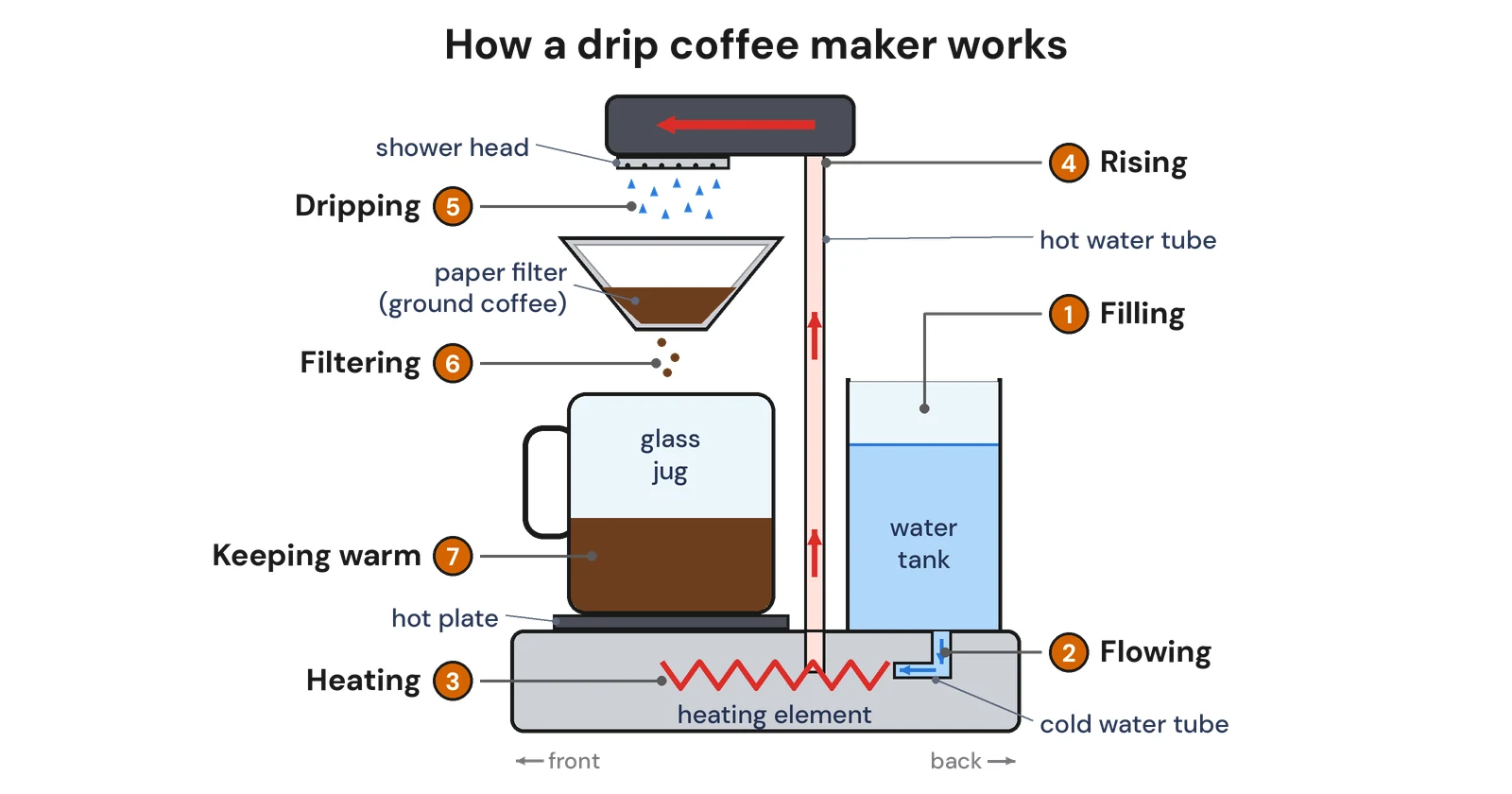
| Stage | Label on the diagram | Detail |
|---|---|---|
| 1 | Filling | cold water poured into the tank |
| 2 | Flowing | down the cold water tube to the heating element |
| 3 | Heating | until the water boils (heating element in the base) |
| 4 | Rising | up the hot water tube |
| 5 | Dripping | through the shower head |
| 6 | Filtering | through the paper filter into the glass jug |
| 7 | Keeping warm | on the hot plate |
The same seven stages as a list, so you can follow the model answer.
Band 9 model answer from the video (188 words)
The diagram illustrates the way in which a filter coffee machine turns cold water into hot coffee.
Overall, there are seven stages, beginning with cold water being poured into a tank and ending with the finished coffee being kept warm. The machine has four main parts, a tank, a heating element, a filter and a jug, and the process has two phases: heating the water and making the coffee.
At the first stage, cold water is poured into a tank at the back of the machine. It then flows down a narrow tube to a heating element, which is located in the base. There, the water is heated until it boils, and it rises up a second tube to the top of the machine.
In the second phase, the hot water passes through a shower head, which is attached to the top of the machine, and drips onto ground coffee in a paper filter. Next, the coffee runs through the filter into a glass jug below. Finally, the jug stands on a hot plate above the heating element, so the coffee is kept warm until it is served.
Chapters in this video (15)
- 0:00Introduction
- 0:56Example Question
- 1:42How a Machine Diagram Is Different
- 2:32How to Read the Diagram
- 3:37Turning Labels into Sentences
- 4:32Passive or Active?
- 5:16Answer Structure
- 5:53Writing the Introduction
- 6:34Writing the Overview
- 7:46Body Paragraph 1 (Heating the Water)
- 8:52Body Paragraph 2 (Making the Coffee)
- 9:51Sequencing and Location Words
- 10:36Three Common Mistakes
- 11:10Final Answer
- 11:37Outro
Sequencing and location words for a machine
| Word / phrase | Meaning | Example |
|---|---|---|
| At the first stage, … / The process begins when … | the first stage | At the first stage, cold water is poured into a tank at the back of the machine. |
| After that / Next / Then / At the following stage | move to the next stage | Next, the coffee runs through the filter into a glass jug below. |
| Finally, … / At the last stage, … | the last stage | Finally, the jug stands on a hot plate above the heating element. |
| at the top / at the back / in the base | say where a part is | It then flows down a narrow tube to a heating element, which is located in the base. |
| above / below | say where one part is compared with another | The coffee runs through the filter into a glass jug below. |
| is attached to / is located in | describe how a part is fixed or placed | The hot water passes through a shower head, which is attached to the top of the machine. |
Practice task: How an electric kettle works
The diagram below shows how an electric kettle works. Summarise the information by selecting and reporting the main features, and make comparisons where relevant. Write at least 150 words.
| Stage | Label on the diagram | Detail |
|---|---|---|
| 1 | Filling | water poured in through the lid at the top |
| 2 | Switching on | switch on the handle; red light comes on |
| 3 | Heating | metal element in the base heats the water |
| 4 | Boiling | water boils; steam rises up a small tube inside the handle |
| 5 | Switching off | steam bends a metal disc under the switch; power cuts off |
| 6 | Pouring | boiling water poured out through the spout at the front |
In the overview, give the number of stages, the first and last stage, and the main parts (lid, switch, heating element, spout).
Choose passive or active for each verb: the water is poured in, the kettle is switched on, but the water boils and the steam rises.
Say where each part is: at the top, in the base, inside the handle, at the front. Split the stages into heating the water (1–4) and switching off and pouring (5–6).
Show model answer (try first!)
The diagram illustrates the way in which an electric kettle heats water and switches itself off when the water boils.
Overall, there are six stages, beginning with water being poured into the kettle and ending with the boiling water being poured out. The kettle has four main parts, a lid, a switch, a heating element and a spout, and the process has two phases: heating the water and switching off.
At the first stage, water is poured in through a lid at the top of the kettle. The kettle is then switched on using a switch on the handle, and a red light comes on. Next, the water is heated by a metal element, which is located in the base, until it boils.
In the second phase, steam rises up a small tube inside the handle and reaches a metal disc under the switch. The heat bends the disc, so the power is cut off automatically. Finally, the boiling water is poured out through a spout at the front of the kettle.
172 words
This practice task and its model answer were written for the website. The real exam shows a drawn diagram; here the stages are listed in a table. For a man-made process, see Example 1: bottled orange juice; for a natural cycle, see Example 2: the life cycle of the ladybird.
Keep going


